


Press releases
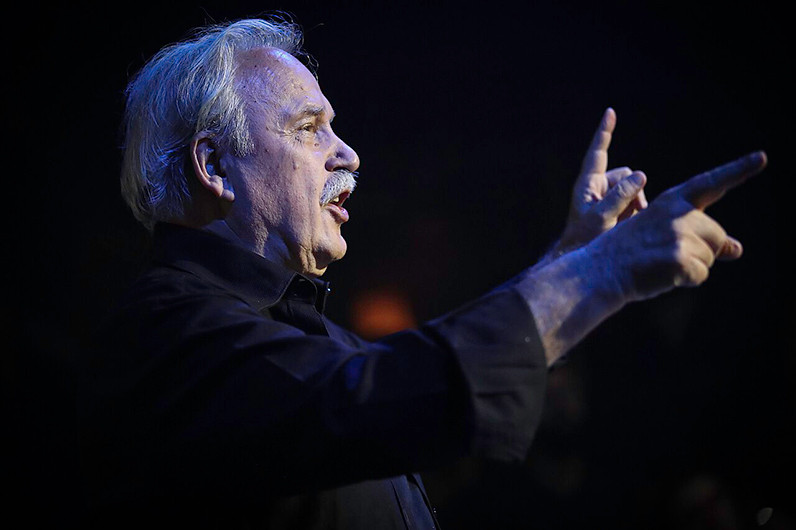
Everybody Calls Me Giorgio: International Conference
08. September 2026
From September 10 to 12, 2026, scholars from around the world will gather at the Free University of Bolzano. They aim to examine the work of South Tyrolean music pioneer Giorgio Moroder and his lasting influence on music, media, and culture. Through its innovative focus on “Electronic Music Producing,” the Pop Academy’s curriculum also builds on Moroder’s pioneering work in the field of Eurodisco in the 1970s. The Pop Academy is therefore a partner in the conference, for which Prof. Dr. David-Emil Wickström provided academic guidance during its planning and execution.
Giorgio Moroder (86) is considered one of the most influential music producers and composers of our time. As a pioneer of electronic music, a co-founder of the disco sound, and an acclaimed film composer, the Val Gardena native has had a lasting impact on the international music scene. From September 10 to 12, 2026, his work will therefore take center stage at the international conference “Everybody Calls Me Giorgio: Moroder Across Media, Arts, and Communication (ECMG26),” which will take place at the Brixen Campus and the Bolzano Center Campus of the Free University of Bozen-Bolzano.Giorgio Moroder, who has held the title of “Senator honoris causa” at unibz since January 2026, was born in Ortisei and grew up as a member of the Ladin linguistic minority. Without any formal musical training, he achieved an international breakthrough—first in Germany and later in the U.S. As a producer for Donna Summer and numerous other artists, as a pioneer of the synthesizer sound, and as a composer of award-winning film scores—including for *Midnight Express*, *Flashdance*, and *Top Gun*—he made music history. His body of work, for which he has been honored with three Oscars and four Grammys, among other awards, continues to have an impact to this day: His compositions are sampled, reinterpreted, and used in film and television productions.This conference aims to shed light on Giorgio Moroder’s role and symbolically brings the Ladin artist—who has lived in Los Angeles for decades—back to his homeland. “From a scholarly perspective, Moroder’s work opens up diverse perspectives on the development and social functions of popular music and film music,” says Carlo Nardi, a researcher at unibz, who is organizing the event together with researcher Ruth Videsott. “The conference facilitates an interdisciplinary examination of music, culture, and society and promotes dialogue between different academic disciplines.”
The conference is organized by two sections of the International Association for the Study of Popular Music (IASPM Italiana and IASPM D-A-CH) and brings together researchers from Europe, North America, and Australia. Local stakeholders will also be involved to foster exchange between international research and regional institutions. The focus is not only on topics such as electronic dance music, music production, film scores, remix cultures, intermediality, and Moroder’s entrepreneurship. The conference also aims to explore sociolinguistic, semiotic, cultural, and historical perspectives and to examine the construction, redefinition, and representation of the identities of artists from linguistic minorities—particularly Ladin speakers—who live and work in migration contexts. Keynote speakers include Prof. Ewa Mazierska from the University of Central Lancashire and Prof. Tavia Nyong’o from Yale University. Paul Harkins (Edinburgh Napier University), Julin Lee (University of Music and Performing Arts Munich), and Maria Perevedentseva (University of Salford) will participate in a panel discussion on the role of synthesizers in relation to topics such as digital culture, automation, and distributed creativity.Symposium: SOUNDS LIKE THE FUTURE in Bolzano
As part of the conference, which is supported by the Ladin Education and Cultural Administration Department of the Autonomous Province of Bolzano, the symposium “SOUNDS LIKE THE FUTURE” will also take place on Saturday, September 12, at the Bolzano Center Campus. In collaboration with the Transart Festival, the symposium—beginning at 9:00 a.m.—will explore the evolution of the relationship between automation and creativity, starting with the influence of Giorgio Moroder’s work. Access to the symposium is reserved for conference participants and Transart guests who have a ticket for the evening event on September 12 at Rothoblaas.You can find all the information and the program here: https://www.unibz.it/it/events/everybody-calls-me-giorgio-moroder-across-media-arts-and-communicationFor interview requests: press@unibz.it